


Why Does Cat Litter Stick to the Box? (And How to Stop It)
Share
If you've ever grabbed a scraper and spent ten minutes chiseling hardened clay off the bottom of a litter box, you already know the frustration. Litter sticking to the pan isn't just annoying — it wastes time, makes a mess, and can even discourage you from scooping as often as you should.
But why does it happen? And more importantly, how do you stop it?
The short answer: it comes down to the **material** your litter is made from and how it behaves when it absorbs liquid. Some litters are practically designed to stick; others release cleanly every time. In this guide, we'll break down the science behind sticking, compare how different litter types perform, and give you practical steps to make your scooping routine faster and cleaner.
---
Why Cat Litter Sticks: The Science
When urine hits the litter, two things happen: the litter **absorbs the liquid** and it **forms a clump**. Whether that clump sticks to the box depends on one key factor: **how the material bonds to itself versus how it bonds to the plastic surface of the pan.**
The Sticking Mechanism
Here's what's happening at a microscopic level:
1. Absorption and expansion.** Some materials — especially bentonite clay — swell significantly when they absorb moisture. That expansion pushes the wet litter flat against the pan, creating a large surface-area contact patch.
2.Adhesion to plastic.** The wet, expanded material forms a semi-solid layer that bonds to the smooth plastic of the litter box. The bond is mechanical: the material fills every tiny groove in the plastic surface and hardens there.
3. Curing and hardening.** As the wet litter sits, it cures into a hard crust. The longer it stays, the stronger the bond becomes. This is why a box that isn't scooped frequently becomes much harder to clean.
Which Materials Stick the Most?
Not all litters behave the same way. Here's how the main types compare:
| Litter Type | Sticking Tendency | Why |
|-------------|-------------------|-----|
| Bentonite clay | 🔴 Very high | Swells on contact with liquid, expands flat against the pan, and cures into a hard crust that bonds to plastic |
| Crystal / silica gel | 🟡 Low | Absorbs liquid into the gel structure rather than clumping, so there's less surface contact with the pan |
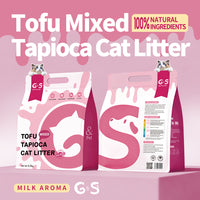
| Tofu (soybean fiber) | 🟡 Moderate | Absorbs quickly but clumps can be soft and may spread before setting, leading to partial sticking |
| Tapioca (cassava starch) | 🟢 Very low | Forms a dense, firm gel that contracts slightly as it sets — the clump pulls away from the pan rather than adhering to it |
The key difference is what happens **after** the litter absorbs liquid. Clay expands and flattens against the surface. Tapioca starch, by contrast, forms a **dense, self-binding gel** that naturally contracts as it cures. Instead of spreading and sticking, the clump tightens into a compact, solid mass that lifts out in one piece.
5 Practical Ways to Reduce Sticking
Even if you're not ready to switch litters, there are things you can do right now to make scooping easier.
1. Switch to a non-stick litter material
This is the single most effective change. If you're using clay and dealing with sticking, the material itself is the root cause. Tapioca-based litters are specifically designed to solve this problem — the cassava starch gel naturally releases from the pan.
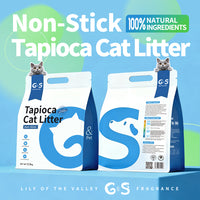
What to look for:** Litters labeled "non-stick" or "hard clumping" that use tapioca or cassava as a primary ingredient. G&S Pet's [Non-Stick Tapioca Cat Litter](https://gspet.shop/products/tapioca-cat-litter), for example, is formulated so that clumps lift out whole without scraping.
2. Use enough litter depth
A shallow litter layer means urine reaches the bottom of the pan faster, where it creates a direct bond with the plastic. Aim for **at least 2–3 inches (5–8 cm)** of litter depth. This gives the liquid enough material to absorb into before it hits the pan surface.
3. Scoop more frequently
The longer a wet clump sits against the plastic, the harder it bonds. Scooping **at least once a day** prevents clumps from curing into a hard crust. If you're away during the day, an automatic litter box can help maintain the schedule.
4. Consider a litter box liner or the right pan material
Some litter boxes have a slightly textured or non-stick coating that reduces adhesion. Plastic pans with a smooth, glossy finish tend to release clumps more easily than matte or scratched surfaces. If your current box is heavily scratched from past scraping, it may be time to replace it — those grooves give litter more surface area to grip.
5. Add a thin base layer of a different litter
Some cat owners layer a small amount of a non-stick litter (like tapioca) at the bottom of the box, then top it with their preferred litter. This creates a release layer between the main litter and the pan. It's a workaround, not a full fix — but it can reduce sticking while you transition.