


Cat Litter Odor Control: Why Your Box Smells and How to Fix It for Real
Share
You've tried the sprays. You've sprinkled baking soda. You've bought the "multi-cat" formula with the mountain-fresh scent. And somehow, the litter box still smells.
Here's the thing: most odor-control advice treats the symptom, not the cause. Fragrances cover up ammonia — they don't eliminate it. Baking soda absorbs some odor but doesn't bind the molecules that produce it. And scented litters? They combine ammonia with perfume into something that smells worse than either one alone.
Real odor control starts with understanding **what causes the smell** and **how different litter materials interact with it**. Once you know that, the fixes are straightforward — and they don't involve masking anything.
What Causes Litter Box Odor?
The primary culprit is **ammonia** (NH₃), a gas produced when urea in cat urine breaks down through bacterial action. Here's the chain:
1. Cat urinates → urea is present in the liquid
2. Bacteria in the litter box environment begin breaking down urea
3. This breakdown releases ammonia gas
4. Ammonia is what you smell — that sharp, burning, unmistakable litter box odor
Several factors accelerate this process:
| Factor | Effect |
|--------|--------|
| Warm temperature | Bacteria multiply faster, producing ammonia more quickly |
| High humidity | Moisture supports bacterial growth and slows evaporation |
| Infrequent scooping | Waste sits longer, giving bacteria more time to produce ammonia |
| Litter that doesn't bind ammonia** | The gas is released freely into the air instead of being trapped |
| Inadequate litter depth*| Urine pools at the bottom instead of being absorbed, creating a concentrated ammonia source |
Secondary odors come from feces (primarily indole and skatole, the compounds responsible for the characteristic fecal smell) and **bacterial growth on residue** left in the box after scooping.
Why Fragrances Don't Work (And Can Make Things Worse)
Adding scent to a litter box is like spraying cologne over a garbage can. You don't eliminate the odor — you add a second one on top of it. The result is often more unpleasant than the original smell.
But there's a bigger problem: cats have a sense of smell roughly 14 times stronger than humans.** A fragrance that seems mild to you is overwhelming to your cat. Strongly scented litters can cause cats to:
- Avoid the box entirely
- Rush their visit and not fully eliminate
- Develop respiratory irritation (especially in breeds with sensitive airways)
If your cat starts avoiding a scented litter box, you've traded an odor problem for a house-soiling problem — which is far worse.
How Different Litter Materials Handle Odor
The key difference between litters isn't how they smell — it's whether they **bind odor molecules** at a chemical level or just sit there while ammonia escapes.
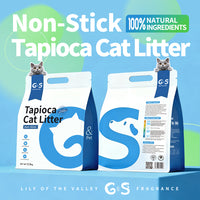
Tapioca (Cassava) Cat Litter — Natural Ammonia Binding
Cassava starch has a molecular structure that **physically traps ammonia molecules** as the starch gel forms around liquid waste. Instead of ammonia gas escaping into the air, it's locked inside the clump.
This is why tapioca litter controls odor effectively without any added fragrance:
- Fast encapsulation — the gel forms within seconds, sealing liquid inside before ammonia can off-gas
- Dense clumps — the compact structure leaves fewer pathways for gas to escape
- No fragrance needed — the odor is contained, not masked
- Long-lasting — because the ammonia is bound inside the clump, it doesn't re-release over time
For households dealing with persistent odor, switching to tapioca is often the single most effective change.
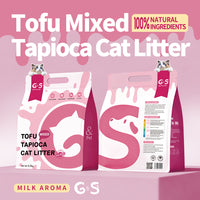
Tofu (Soybean Fiber) Cat Litter — Fast Absorption, Moderate Odor Control
Tofu litter absorbs liquid very quickly, which helps reduce the initial ammonia release. However:
- Tofu's fiber structure is more porous than tapioca's gel, meaning some ammonia can still escape through the clump.
- Pure tofu litters often add natural deodorizers (like green tea extract or activated carbon) to compensate.
- Works well for odor control when combined with frequent scooping.
Bentonite Clay — Fragrance-Dependent
Clay litter absorbs liquid and forms clumps, but it doesn't chemically bind ammonia. Instead, most clay litters rely on:
- Added fragrance to mask the smell
- Activated carbon (in some formulas) to absorb some odor molecules
- Encapsulation — the clay swells around the liquid, which provides some physical containment
The problem: as the clay dries and the fragrance fades, ammonia can re-release. This is why a clay box often smells fine right after scooping but gets worse by the end of the day.
Crystal / Silica Gel — Absorbs Moisture, Limited Odor Binding
Silica gel crystals absorb liquid into their porous structure, which reduces the moisture available for bacterial growth. This slows ammonia production but doesn't stop it entirely. Once the crystals are saturated, odor can become intense very quickly.
---
Practical Steps to Eliminate Litter Box Odor
Beyond choosing the right litter, these habits make a real difference:
1. Scoop twice daily
This is non-negotiable. Every hour waste sits in the box, bacteria are producing more ammonia. Morning and evening scoops remove the source before it builds up.
2. Replace litter fully every 2–3 weeks
Scooping removes clumps but leaves microscopic residue. Over time, this residue becomes a bacterial breeding ground. A full replacement — dump everything, wash the pan, start fresh — eliminates this buildup.
3. Wash the box with mild soap, not harsh chemicals
Bleach and ammonia-based cleaners can leave residue that actually makes odor worse (and mixing bleach with residual cat urine can produce toxic fumes). Use mild dish soap and warm water. Let the pan dry completely before refilling.
4. Maintain proper litter depth
2–3 inches (5–8 cm) of litter gives waste enough material to absorb into before reaching the pan. Shallow litter means urine pools at the bottom, creating a concentrated ammonia source that's hard to scoop away.
5. Position the box with ventilation in mind
A box in a tiny, enclosed space with no airflow traps ammonia. If you use a covered box, ensure the vent is unobstructed. If possible, place the box in a room with some natural airflow — not a closet or cabinet.
6. Replace scratched or worn boxes
Plastic litter boxes develop microscopic scratches over time from scooping. These scratches harbor bacteria that produce ammonia even when the box looks clean. If your box is more than a year old or visibly scratched, replace it.
7. Check your cat's diet
High-protein diets produce more concentrated urine, which means more urea and potentially more ammonia. This doesn't mean you should switch to a low-protein food (cats need protein), but it does mean that cats on high-protein diets may need more frequent scooping or a litter with better ammonia binding.