


Best Cat Litter for Automatic Litter Boxes: What Works and What Doesn't
Share
Automatic litter boxes promise a hands-off routine: the machine senses when your cat is done, cycles through a sifting or raking motion, and deposits waste into a sealed compartment. In theory, you just empty the tray every few days.
In practice, the litter you put in that machine makes or breaks the whole experience. The wrong litter jams the mechanism, smears across the rake, or crumbles into dust that clogs the filter. The right litter sifts cleanly, clumps firmly, and keeps the machine running smoothly with minimal maintenance.
So which litters actually work? Let's break it down.
How Automatic Litter Boxes Work (And Why Litter Choice Matters)
Most automatic boxes fall into one of two design categories:
| Type | How it works | What the litter needs to do |
| Rake-style | A metal or plastic rake drags across the pan, pushing clumps into a waste compartment | Clumps must be firm enough to stay intact when the rake passes — soft or sticky clumps smear or break apart |
| Rotating / sifting drum | The entire drum rotates, sifting litter through a screen or grate while clumps stay behind | Granules must be small enough to pass through the screen; clumps must be compact enough not to break apart during rotation |
In both designs, the litter has to do three things well:
1. Clump firmly — so waste stays intact during the sifting or raking motion
2. Sift cleanly — so the mechanism can separate waste from clean litter without jamming
3. Resist crumbling— so clumps don't shatter into small pieces that fall back through the screen and stay in the pan
If any one of these fails, you get jams, smears, or a machine that can't tell the difference between clean and dirty litter.
Litter Types Ranked for Automatic Boxes
Here's how the main litter materials perform in automatic boxes, based on how they actually behave during the sifting or raking cycle:
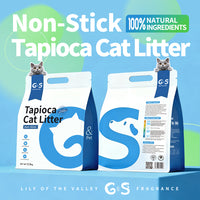
🟢 Best: Tapioca (Cassava) Cat Litter
Tapioca litter is one of the best choices for automatic boxes, and here's why:
- Firm, compact clumps that hold their shape when the rake passes or the drum rotates. They don't smear, they don't shatter — they move as a single solid piece.
- Non-stick — clumps release cleanly from the pan surface, so the rake doesn't have to fight adhesive bonds.
- Low dust — minimal fine particles to clog filters or coat the sensor.
- Granule size — small enough to sift through standard screens, but dense enough not to float or scatter during rotation.
Tapioca litter's key advantage is that it **doesn't crumble under mechanical stress**. When a rake pushes a tapioca clump, the clump slides as a unit. When a drum rotates, the clump stays intact. This means less waste left behind, fewer jams, and a cleaner machine overall.
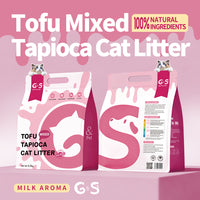
🟢 Good: Tofu-Tapioca Mixed Litter
A blend of tofu and tapioca combines two strengths:
- Tofu absorbs liquid fast, which means clumps form quickly — important if your cat uses the box and the machine cycles shortly after.
- Tapioca firms up the clump so it holds together during sifting.
A 60/40 tofu-to-tapioca ratio works well: the tofu handles speed, the tapioca handles durability. The result is a clump that forms fast and stays intact through the machine's cycle.
🟡 Acceptable: Tofu (Soybean Fiber) Cat Litter
Pure tofu litter works in some machines but has a caveat:
- Clumps form quickly and are soft, which is fine for gentle rake-style boxes.
- In rotating drums or aggressive rakes, **soft tofu clumps can break apart**, leaving fragments that fall back through the screen.
- Works best in machines with a slower, more deliberate raking motion.
If you use tofu litter in an automatic box, choose one with a gentle cycle and consider a slightly deeper litter bed to give clumps more support.
🟡 Acceptable: Crystal / Silica Gel Litter
Crystal litter doesn't clump at all — it absorbs liquid into the gel granules. This means:
- No clumps to sift, which eliminates the jamming risk entirely.
- The machine simply rotates or rakes to separate solid waste; the wet crystals stay in the pan and continue absorbing.
- Downside: because there are no clumps, the machine can't separate urine-saturated crystals from dry ones. You're relying on the crystals' absorption capacity, and when they're full, the entire pan needs changing.
Crystal litter works in some automatic boxes (especially rotating ones), but it defeats one of the main benefits of an automatic box — the ability to separate and contain waste.
5 Tips for Using Any Litter in an Automatic Box
Regardless of which litter you choose, these practices will keep your machine running smoothly:
1. Fill to the right level
Most automatic boxes have a fill-line indicator. Overfilling means the rake or drum has to move too much material, straining the motor. Underfilling means urine reaches the bottom before the litter can absorb it, leading to sticking and odor. Follow the manufacturer's recommended fill level — usually 2–3 inches.
2. Don't let the waste compartment overflow
An overfull waste tray can push back into the sifting area, causing jams. Empty the tray when it's about ¾ full, not when it's packed.
3. Wipe down the rake or screen weekly
Even with the best litter, a small amount of residue builds up over time. A quick wipe with a damp cloth once a week prevents buildup that could cause sticking or jamming.
4. Do a full deep-clean monthly
Empty the entire box, wash the pan and mechanism with mild soap and water, and let everything dry completely before refilling. This prevents odor buildup and keeps sensors clean.
5. Match the cycle delay to your litter
Most automatic boxes let you set a delay between your cat leaving the box and the cycle starting. For fast-clumping litters (tapioca, tofu), a 5–7 minute delay is usually enough. For slower-clumping litters, extend the delay to 10–15 minutes to give clumps time to firm up before the machine touches them.
What About Multi-Cat Households?
If you have two or more cats sharing an automatic box, the machine works harder — more cycles, more waste, more wear on the mechanism. In this scenario, a **firm-clumping, low-dust litter becomes even more important** because:
- The machine cycles more frequently, so clumps need to form and firm up fast.
- More cycles mean more mechanical stress on each clump.
- Higher traffic means more dust gets kicked up — low-dust litter keeps the air and the machine cleaner.
A tapioca or tofu-tapioca blend is especially well-suited for multi-cat automatic box setups because it handles frequent cycling without degrading.